| Mohammed Rafi | |
|---|---|
 | |
| Born | (1924-12-24)24 Dec 1924 Kotla Sultan Singh, Punjab, British India |
| Died | 31 July 1980(1980-07-31) (aged 55) Mumbai, Maharashtra, India |
| Nationality | Indian |
| Occupation |
|
| Years active | 1944–1980 |
| Awards |
|
| Honours | Padma Shri (1967) |
| Musical career | |
| Genres |
|
| Instruments | Vocals, Harmonium |
| Signature | |
 | |
Mohammed Rafi (24 Dec 1924 – 31 July 1980) was an Indian film playback vocalizer. He is considered i of the greatest and most influential singers of the Indian subcontinent.[ii] [three] Rafi was notable for his versatility and range of vocalization; his songs varied from fast peppy numbers to patriotic songs, sad numbers to highly romantic songs, qawwalis to ghazals and bhajans to classical songs.[4] He was known for his ability to mould his vocalism to the persona and way of the histrion lip-syncing the vocal on screen in the movie.[five] He received six Filmfare Awards and one National Movie Award. In 1967, he was honored with the Padma Shri honour past the Government of Bharat. In 2001, Rafi was honoured with the "All-time Singer of the Millennium" championship by Hero Honda and Stardust magazine. In 2013, Rafi was voted for the Greatest Voice in Hindi Movie theatre in the CNN-IBN'due south poll.[6]
He recorded songs for over a thousand Hindi films and in many Indian languages every bit well as some foreign languages, though primarily in Urdu and Punjabi, over which he had a strong command. He recorded every bit many equally seven,000 songs throughout his career, spanning several languages and dialects such as Konkani, Assamese, Bhojpuri, Odia, Bengali, Marathi, Sindhi, Kannada, Gujarati, Tamil, Telugu, Magahi, Maithili, etc. Autonomously from Indian languages, he also sang in some foreign languages, including English, Farsi, Arabic, Sinhala, Mauritian Creole, and Dutch.[vii]
Early on life

Mohammed Rafi was the 2d eldest of six brothers born to Haji Ali Mohammad. The family originally belonged to Kotla Sultan Singh, a village near present-day Majitha in Amritsar district of Punjab, India.[8] Rafi, whose nickname was Pheeko, began singing by imitating the chants of a fakir who roamed the streets of his native hamlet Kotla Sultan Singh. Rafi's father moved to Lahore in 1935, where he ran a men's barbershop in Noor Mohalla in Bhati Gate.[ix] Rafi learnt classical music from Ustad Abdul Wahid Khan, Pandit Jiwan Lal Mattoo and Firoze Nizami.[ten] His beginning public operation came at the age of xiii, when he sang in Lahore featuring K. L. Saigal. In 1941, Rafi made his debut in Lahore as a playback vocalizer in the duet "Soniye Nee, Heeriye Nee" with Zeenat Begum in the Punjabi movie Gul Baloch (released in 1944) under music director Shyam Sunder.[eleven] In that same year, Rafi was invited by All India Radio Lahore station to sing for them.[12]
He made his Hindi flick debut in Gaon Ki Gori in 1945.[five]
Early career in Mumbai (then Bombay)
Rafi moved to Bombay (now Mumbai), Maharashtra in 1944. He and Hameed Sahab rented a ten-by-ten-feet room in the crowded downtown Bhendi Bazar area. Poet Tanvir Naqvi introduced him to moving picture producers including Abdur Rashid Kardar, Mehboob Khan and player-director Nazeer.[13] Shyam Sunder was in Bombay and provided the opportunity to Rafi to sing a duet with G. M. Durrani, "Aji dil ho kaabu mein to dildar ki aisi taisi...," for Gaon Ki Gori, which became Rafi's showtime recorded vocal in a Hindi film. Other songs followed.
Rafi's first song with Naushad was "Hindustan Ke Hum Hain" with Shyam Kumar, Alauddin and others, from A. R. Kardar's Pehle Aap (1944). Around the same fourth dimension, Rafi recorded another song for the 1945 movie Gaon Ki Gori, "Aji Dil Ho Kaaboo Mein". He considered this song to be his commencement Hindi language song.[12]
Rafi appeared in two movies. He appeared on the screen for the songs "Tera Jalwa Jis Ne Dekha" in movie Laila Majnu(1945) and "Woh Apni Yaad Dilane Ko" in the Film Jugnu (1947).[12] He sang a number of songs for Naushad as office of the chorus, including "Mere Sapnon Ki Rani, Roohi Roohi" with Thou. L. Saigal, from the film Shahjahan (1946). Rafi sang "Tera Khilona Toota Balak" from Mehboob Khan's Anmol Ghadi (1946) and a duet with Noor Jehan in the 1947 picture Jugnu, "Yahan Badla Wafa Ka". Later partition, Rafi decided to stay back in Bharat and had the remainder of his family unit flown to Bombay. Noor Jehan migrated to Pakistan and made a pair with playback singer Ahmed Rushdi.
In 1949, Rafi was given solo songs by music directors such as Naushad (Chandni Raat, Dillagi and Dulari), Shyam Sunder (Bazaar) and Husnalal Bhagatram (Meena Bazaar).
Besides K. 50. Saigal, whom he considered his favorite, Rafi was also influenced by G. K. Durrani. In the early on stage of his career, he often followed Durrani's style of singing, but later evolved his own, unique style. He sang with Durrani in some of the songs such every bit "Humko Hanste Dekh Zamana Jalta Hai" and "Khabar Kisi Ko Nahiin, Woh Kidhar Dekhte" (Beqasoor, 1950).
In 1948, later the assassination of Mahatma Gandhi, the squad of Husanlal Bhagatram-Rajendra Krishan-Rafi had overnight created the song "Suno Suno Ae Duniyawalon, Bapuji Ki Amar Kahani". He was invited by the Indian Prime Minister, Jawaharlal Nehru, to sing at his house. In 1948, Rafi received a silver medal from Jawaharlal Nehru on Indian Independence Day.[14]

With Raj Kamal and Asad Bhopali
Recording career in the 1950s and 1960s
In his early career, Rafi associated with many gimmicky music directors, most notably Naushad Ali. In the late 1950s and 1960s, he worked with other composers of the era such every bit O. P. Nayyar, Shankar Jaikishan, S.D. Burman and Roshan.
Work with Naushad
As per Naushad, Rafi came to him with a letter of recommendation from Naushad'southward father.[15] Rafi'southward first vocal for Naushad Ali was "Hindustan Ke Hum Hain" ("We belong to Hindustan") for the motion-picture show Pehle Aap in 1944. The first vocal for the duo was the soundtrack of the movie Anmol Ghadi (1946).
Rafi's association with Naushad helped the quondam plant himself as ane of the most prominent playback singers in Hindi cinema.[12] Songs from Baiju Bawra (1952) like "O duniya ke rakhwale" and "Homo tarpat hari darshan ko aaj" furthered Rafi's credentials.[11] Rafi ended upward singing a total of 149 songs (81 of them solo) for Naushad. Earlier Rafi, Naushad'due south favorite singer was Talat Mahmood. Once Naushad establish Talat smoking during a recording.[sixteen] [17] [18] [ self-published source? ] He was bellyaching and hired Rafi to sing all the songs of the movie Baiju Bawra.
Piece of work with S. D. Burman
S. D. Burman used Rafi equally a singing phonation of Dev Anand and Guru Dutt.[19] Rafi worked with Burman in 37 films, including Pyaasa (1957), Kaagaz Ke Phool (1959), Kala Bazar (1960), Nau Do Gyarah (1957), Kala Pani (1958), Tere Ghar Ke Saamne (1963), Guide (1965), Aradhana (1969), Ishq Par Zor Nahin (1970) and Abhimaan (1973).
Work with Shankar–Jaikishan
Rafi's partnership with Shankar–Jaikishan was amongst the nigh famous and successful in the Hindi film industry. He worked with them from their first moving-picture show, Barsaat (1949). Nether Shankar–Jaikishan, Rafi produced some of his songs for actors similar Shammi Kapoor and Rajendra Kumar. Out of six Filmfare awards, Rafi won iii for S-J songs – "Teri Pyaari Pyaari Surat Ko", "Bahaaron Phool Barsaao" and "Dil Ke Jharokhe Mein." The song "Yahoo! Chaahe Koi Mujhe Junglee Kahe" was sung by Rafi, matched by a fast-paced orchestra and composition by Shankar Jaikishan. S-J had Rafi give playback for Kishore Kumar in the picture Sharaarat ("Ajab Hai Daastaan Teri Ye Zindagi"). Rafi sang a total of 341 numbers—216 solo—for Shankar–Jaikishan.[20] Among the films of this combination are: Awaara, Boot Polish, Basant Bahar, Professor, Junglee, Asli-Naqli, Rajkumar, Suraj, Sangam, Brahmachari, Arzoo, An Evening in Paris, Dil Tera Deewana, Yakeen, Prince, Love in Tokyo, Beti Bete, Dil Ek Mandir, Dil Apna Aur Preet Parai, Gaban and Jab Pyar Kisi Se Hota Hai.
Piece of work with Ravi
Rafi got his beginning Filmfare Award for the title song of Chaudhvin Ka Chand (1960), composed past Ravi. He received the National Honor for the song "Baabul Ki Duaen Leti Jaa" from the motion picture Neel Kamal (1968), likewise composed past Ravi. Rafi wept during the recording of this song, which he admitted in a 1977 interview with the BBC.[21]
Ravi and Rafi produced several other songs in the films China Town (1962), Kaajal (1965), Practice Badan (1966) and Ek Phool Do Maali (1969)
Piece of work with Madan Mohan
Madan Mohan was some other composer whose favorite vocalizer was Rafi. Rafi'southward first solo with Madan Mohan in Aankhen (1950) was "Hum Ishk Mein Burbaad Hein Burbaad Ruhenge".[12] They teamed up to produce many songs including "Teree Aankhon Ke Sivaa", "Yeh Duniyaa Yeh Mehfil", "Tummy Jo Mil Guye Ho", "Kur Chale Hum Fida", "Meree Aawaaz Suno" and "Aap Ke Pehlu Mein Aakur".
Work with O. P. Nayyar
Rafi and O. P. Nayyar (OP) created music in the 1950s and 1960s. O. P. Nayyar was once quoted as saying "If in that location had been no Mohammed Rafi, there would take been no O. P. Nayyar".[22]
He and Rafi created many songs together including "Yeh Hai Bombay Meri Jaan". He got Rafi to sing for singer-actor Kishore Kumar – "Man Mora Baawara" for the movie Raagini. After, Rafi sang for Kishore Kumar in movies such as Baaghi, Shehzaada and Shararat. O. P. Nayyar used Rafi and Asha Bhosle for almost of his songs. The team created many songs in the early on 1950s and 1960s for movies such as Naya Daur (1957), Tumsa Nahin Dekha (1957), Ek Musafir Ek Hasina (1962) and Kashmir Ki Kali (1964). Rafi sang a total of 197 numbers (56 solo) for Nayyar.[23] The songs "Jawaaniyan yeh mast mast" and the title song "Yun to humne lakh hansee dekhe hain, tumsa nahin dekha" of the film Tumsa Nahin Dekha were hits. They were followed past songs like "Yeh Chand Sa Roshan Chehera" from Kashmir ki Kali.
Rafi and OP had a falling-out during the recording for movie "Sawan ki Ghata". As disclosed by OP during 1 of his interviews; Rafi reported late to the recording stating that he was stuck in Shankar Jaikishan'due south recording. OP and so stated that from now on he besides did not have the time for Rafi and cancelled the recording. They did not work together for the side by side 3 years.[24]
Work with Laxmikant-Pyarelal
The composer duo Laxmikant–Pyarelal (L-P) patronized Rafi as one of their singers, correct from their very offset vocal by him from the film Parasmani (1963). Rafi and L-P won the Filmfare Award for the song "Chaahoonga Mein Tujhe Saanjh Suvere" from Dosti (1964). Rafi rendered the highest number of songs for this music director duo Laxmikant-Pyarelal, as compared to all the music directors: 388.[xx]
Once, when composer Nisar Bazmi, who in one case worked with Laxmikant-Pyarelal earlier he had migrated to Pakistan, didn't have enough money to pay him, Rafi charged a fee of one rupee and sang for him. He too helped producers financially. As Laxmikant in one case observed – "He ever gave without thinking of the returns".
Work with Kalyanji Anandji
Kalyanji Anandji composed around 170 songs in the voice of Rafi. Kalyanji's human relationship with Rafi started with the 1958 film, Samrat Chandragupta, his debut film as a solo composer.[25] Kalyani-Anandji and Rafi went on to work together for the music of the Shashi Kapoor-starrer Haseena Maan Jayegi (1968), which featured songs similar "Bekhudi Mein Sanam" and "Chale The Saath Milke".[25]
Piece of work with contemporary singers
Rafi associated with several of his contemporaries, singing duets with them and sometimes for them (equally in case of Kishore Kumar who was also an role player). Rafi sang the highest number of duets with Asha Bhosle (female), Manna Dey (male) and Lata Mangeshkar (female).
In the song "Humko Tumse Ho Gaya Hai Pyaar" (Amar Akbar Anthony), Rafi sang one song with Kishore Kumar, Lata Mangeshkar, and Mukesh, the most legendary singers in Bollywood. This was probably the but time that all of them rendered their voices for ane vocal.[26]
Work with other music directors
Rafi sang frequently for all music directors during his lifetime, including Roshan, Jaidev, Khayyam, Rajesh Roshan, Ravindra Jain, Bappi Lahiri, Sapan Jagmohan etc. He had a special and major association with Usha Khanna, Sonik Omi, Chitragupta, S.N. Tripathi, N. Datta and R.D. Burman. He also sang for many small time and bottom-known music directors. Many for whom he sang for free while making their compositions immortal; he selflessly believed in financially assisting producers and helping small-time projects who could not afford much. Many in the industry received regular financial help from Rafi.[27]
Individual albums
Rafi sang several songs in Chris Perry's Konkani album Gilded Hits with Lorna Cordeiro. He recorded many private albums in various genres and languages. Rafi recorded Hindi songs in English on 7" release in 1968. He besides sang ii songs in Mauritian Creole while on his visit to Republic of mauritius in the late 1960s.
Royalty issue
In 1962–1963, the popular female person playback singer Lata Mangeshkar raised the issue of playback singers' share in the royalties. Recognizing Rafi'southward position as the leading male playback singer, she wanted him to dorsum her in demanding a half-share from the five% song royalty that the film'south producer conceded to select composers. Rafi refused to side with her, stating that his claim on the film producer's money ended with his being paid his agreed fee for the song. Rafi argued that the producer takes fiscal take chances and the composer creates the song, so the vocaliser does not take any claim over the royalty coin. Lata viewed his stand every bit a stumbling block on the royalty event and stated that it is because of the singer's name also that the records get sold. This difference of stance afterwards led to differences between the two. During the recording of "Tasveer Teri Dil Mein" (Maya, 1961), Lata argued with Rafi over a sure passage of the song. Rafi felt belittled, equally music director Salil Chowdhury sided with Lata. The situation worsened when Lata alleged that she would no longer sing with Rafi. Rafi stated that he was merely so keen to sing with Lata as she was with him.[28] [29] The music director Jaikishan later negotiated a reconciliation between the ii.[30] In an interview given to The Times of India on 25 September 2012, Lata claimed to have received a written apology from Rafi.[31] Still, Shahid Rafi, Mohammad Rafi'due south son, rebuffs the claim, calling information technology an human action to dishonour his begetter's reputation.[31]
Early on 1970s
In the 1970s, Rafi suffered from a throat infection for an extended catamenia of time.[32] During a brief period then, he recorded relatively fewer songs.[28] [33] Although his musical output was relatively depression during this period, he did sing some of his best numbers then.[34]
In the early on '70s, Rafi suffered a major setback, when Kishore Kumar emerged as the master Bollywood playback vocaliser, with Aradhana.
He could recover some of the lost ground in 1977, but the main songs of the period were past Kishore Kumar.
Some of Rafi's striking songs of the early 1970s were with music directors: Laxmikant–Pyarelal, Madan Mohan, R. D. Burman and Southward. D. Burman. These include "Breadbasket Mujhe Yun Bhula Naa Paoge" (a signature song of 1971), from Pagla Kahin Ka; "Yeh Duniya Yeh Mehfil" from Heer Ranjha (1970); "Kaan Mein Jhumka" from Sawan Bhadon; "Jhilmil Sitaron Ka" from Jeevan Mrityu (1970); "Gulabi Aankhen" from The Railroad train (1970); "Yun Hi Tum Mujhse Baat" from Sachaa Jhutha; "Yeh Jo Chilmun Hei" and "Itna To Yaad Hei Mujhe" from Mehboob Ki Mehndi (1971); "Mera Man Tera Pyaasa" from Gambler; "Chadhti Jawani" and "Kitna Pyara Vada" from Caravan (1971); "Chalo Dildaar Chalo" from Pakeezah (1972); "Chura Liya Hai Tumne" from Yaadon Ki Baaraat (1973); "Na Tu Zumeen Ke Liye" from Dilip Kumar'south movie Dastaan (1972); "Tum Jo Mil Gaye Ho" from Hanste Zakhm (1973); "Tere Bindiya Re", from Abhimaan (1973) and "Aaj Mausam Bada Beimaan Hai" from Loafer (1973).
Later years
Rafi made a comeback equally a leading singer in mid 1970s. In 1974 he won the Movie Globe magazine All-time Singer Laurels for the song "Teri Galiyon Mein Na Rakhenge Kadam Aaj Ke Baad" (Hawas, 1974) equanimous by Usha Khanna.[20]
In 1976, Rafi sang all the songs for Rishi Kapoor in the hit motion-picture show Laila Majnu.[35] Rafi went on to sing many more than songs for Rishi Kapoor in the subsequent hit films, including Hum Kisise Kum Naheen (1977) and Amar Akbar Anthony (1977).[36] In 1977, he won both Filmfare Award and the National Award for the vocal "Kya Hua Tera Wada" from the movie Hum Kisise Kum Naheen, equanimous by R. D. Burman.[xix] He was nominated equally the best vocaliser at the Filmfare Awards for the qawwali "Parda Hai Parda" from Amar Akbar Anthony (1977).
Rafi sang for many successful films in the late 1970s and the early on 1980s many of whose hit songs were dominating the charts in the late 70s on radio programs such every bit Vividh Bharati, Binaca Geetmala and Radio Ceylon. [37] Some of these include Pratiggya (1975), Bairaag (1976), Amaanat (1977), Dharam Veer (1977), Apnapan (1977), Ganga Ki Saugand (1978), Suhaag (1979), Sargam (1979), Qurbani (1980), Dostana (1980), Karz (1980), The Burning Train (1980), Abdullah (1980), Shaan (1980), Aasha (1980), Aap To Aise Na The (1980), Naseeb (1981) and Zamaane Ko Dikhana Hai (1981). In 1978, Rafi gave a operation at the Purple Albert Hall and in 1980 he performed at the Wembley conference centre. From 1970 until his death he toured effectually the world extensively giving concert performances to packed halls.
In December 1979, Rafi recorded 6 songs for the Hindi remake of Dilip Sen'due south Bengali superhit Deplorable Madam; the moving picture was never completed due to a personal tragedy in Dilip Sen's life. These songs, written by Kafeel Aazar and composed by Chitragupta, were released digitally in Dec 2009 by the label Silk Road under the championship "The Last Songs".[38] The physical anthology was released simply in India by Universal.[ citation needed ]
Guinness World Records controversy
During his terminal years, Rafi was involved in a controversy over Lata Mangeshkar'due south entry in the Guinness Book of Earth Records. In a letter of the alphabet dated 11 June 1977 to the Guinness Book of Earth Records, Rafi had challenged the claim that Lata Mangeshkar has recorded the highest number of songs ("not less than 25,000" according to Guinness). Rafi, according to his fans, would have sung more songs than Lata – he beingness the senior of the two. They estimated the number of songs sung by Rafi to be anything from 25,000 to 26,000. This prompted Rafi to write a letter, in protest, to Guinness.[39] Later on receiving a reply from Guinness, in a letter dated 20 Nov 1979, he wrote, "I am disappointed that my request for a reassessment vis-a-vis Ms Mangeshkar's reported globe record has gone unheeded."[26] In an interview to BBC recorded in November 1977, Rafi claimed to have sung 25,000 to 26,000 songs till then.[22]
After Rafi's expiry, in its 1984 edition, the Guinness Book of Globe Records gave Lata Mangeshkar's name for the "About Recordings" and stated, "Mohammad Rafi (d 1 Baronial 1980) [sic] claimed to accept recorded 28,000 songs in 11 Indian languages betwixt 1944 and April 1980."[40] The Guinness Book entries for both Rafi and Lata were eventually deleted in 1991. In 2011, Lata'due south sis Asha Bhosle was given the title.[41]
Mohammed Rafi – Golden Voice of the Silver Screen, a 2015 book by Shahid Rafi and Sujata Dev, states that according to "industry sources", Rafi sang iv,425 Hindi pic songs, 310 non-Hindi film songs, and 328 non-pic songs between 1945 and 1980.[39] A 2015 Manorama Online article states that "researchers" have found 7,405 songs sung by Rafi.[42]
Among the prominent leading actors of his fourth dimension, Rafi sung 190 songs for Shammi Kapoor, 155 for Johnny Walker, 129 for Shashi Kapoor, 100 for Dev Anand and 77 for Dilip Kumar.[43]
Death
Mohammed Rafi died at 10:25 pm on 31 July 1980, following a massive heart attack, aged 55.[44] The last song sung past Rafi was for the movie Aas Paas, with music past Laxmikant-Pyarelal. I source says it was "Shaam Phir Kyun Udaas Hai Dost / Tu Kahin Aas Paas Hai Dost", recorded only hours before his death.[26] [45] [46] Another source says that information technology was "Shehar mein charcha hai" from the same flick.[47]
Rafi was cached at the Juhu Muslim cemetery and his burial was one of the largest funeral processions in India as over 10,000 people attended his burial.[48] The government of India announced a two-day public mourning in his honour.[26]
In 2010, Rafi's tomb along with many picture show industry artists such equally Madhubala, was demolished to brand space for new burials. Fans of Mohammed Rafi, who visit his tomb twice a year to marking his birth and death anniversaries, use the kokosnoot tree that is nearest his grave as a marker.[49]
Legacy
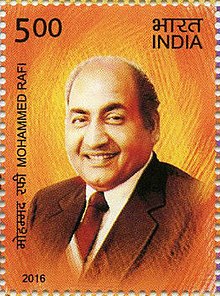
Rafi on a 2016 stamp of India
Singers like Mahendra Kapoor, Mohammed Aziz, Shabbir Kumar, Southward. P. Balasubrahmanyam, Udit Narayan and Sonu Nigam were influenced by Rafi'due south style of singing.[50] [51] Anwar also imitated Rafi's vocalism.
On 22 September 2007, a shrine to Rafi designed past artist Tasawar Bashir was unveiled on Fazeley Street, Birmingham, UK. Bashir is hoping that Rafi volition attain sainthood as a event.[52] [53] The Padma Shri Mohammed Rafi Chowk in the Bandra suburb of Mumbai and Pune (extending MG Route) is named afterwards Rafi.[54]
In the summer of 2008, the City of Birmingham Symphony Orchestra released a double CD titled Rafi Resurrected comprising 16 songs by Rafi. Bollywood playback vocalizer Sonu Nigam provided the vocals for this projection and toured with the CBSO in July 2008 at venues including the English language National Opera in London, Manchester's Apollo Theatre and Symphony Hall, Birmingham.[55]
In June 2010, Rafi along with Lata Mangeshkar was voted the most popular playback singer in the Outlook Music Poll, conducted by Outlook mag.[56] The same poll voted "Man re, tu kahe na dheer dhare" (Chitralekha, 1964), sung by Rafi as the No. ane vocal.[57] Iii songs were tied for the No. ii place: Two were sung by Rafi. The songs were "Tere mere sapne ab ek rang hain" (Guide, 1965) and "Din dhal jaye, hai raat na jaye" (Guide, 1965). This poll was published in Outlook. The jury included people in the Indian music industry.[58]
In 2015, the Britain-based newspaper Eastern Eye placed Rafi third in their "Greatest 20 Bollywood Playback Singers" list.[59]
There accept been appeals[60] to the Government of Bharat to honour the vocalizer, posthumously, with the Bharat Ratna (India'due south Highest Civilian Honour)
An official biography was written on Rafi'southward life by Sujata Dev titled Mohammed Rafi – Golden Voice of the Silver Screen launched on his 91st altogether.[61] Too as an award winning documentary titled Dastaan-E-Rafi directed by Rajni Acharya and Vinay Patel (which took v years to make) was released to commemorate his 92nd birthday which was later released on DVD. It featured over lx interviews of various Bollywood personas and closely recalled his story through his songs and the personal recounts.[62] [63] Many biographies and documentaries continue to be written and made on him.[ citation needed ]
Lata Mangeshkar his contemporary, has said that 'Rafi bhaiya was not simply India's greatest playback vocalist but also a wonderful person' and that 'he was ane singer whose song range could outclass any other singer, whether it was me, Asha, Mannada or Kishore bhaiya".[two]
When producer-director Manmohan Desai (who was a large fan of Rafi) and used him in numerous hit films, was asked to describe the vocalisation of Rafi he remarked that "If anyone has the voice of god, it is Mohammed Rafi".[64]
Annually his nascency and expiry anniversaries inspire several 1000 musical tributes on stage, radio and television.[65] [66]
Rafi'due south popularity today spans across the Indian sub-continent, having a reach to Indian communities in Singapore and Malaysia.[67] [68] [69]
Today, Rafi'south popular songs continue to be remixed or recreated.[lxx]
Rafi'due south Baharon Phool Barsao was voted the most popular Hindi song in a BBC Asia Network poll commemorating 100 years of Hindi Picture palace.[71]
In a CNN-IBN survey in 2013, he was voted the greatest phonation of Hindi Movie theater.[72]
In 2001, Rafi was named as the "best singer of the millennium" by Hero Honda and Stardust magazine.[73]
In popular civilization
- Mohammed Rafi University was launched in Mumbai on 31 July 2010 on the 30th anniversary of the singer'southward death, started by his son Shahid Rafi to impart training in Indian classical and contemporary music.[74] [75]
- After his death, numerous Hindi movies were dedicated to Rafi, including: Allah Rakha, Mard, Coolie, Desh-Premee, Naseeb, Aas-Paas and Heeralal-Pannalal.[76]
- A song in the 1990 Hindi motion picture Kroadh "Na Fankar Tujhsa" picturised on role player Amitabh Bachchan and sung by vocalizer Mohammed Aziz was besides dedicated to the memory of Rafi.
- Rafi is ane of the recording artists mentioned in the 1997 hitting British alternative rock vocal "Awash of Asha" past Cornershop.[77]
- Rafi's vocal from the pic Gumnaam (1965), "Jaan Pehechan Ho", was used on the soundtrack of Ghost Globe (2001). The movie opens with the lead character dancing around in her bedroom to a video of Gumnaam.[78] The song has also been used for Heineken'southward 2011 "The Date" commercial.[79]
- Rafi was commemorated on his 93rd birth anniversary by Search Engine Google which showed a special doodle on its Indian home page for him on 24 December 2017.[80]
- His "Aaj Mausam Bada Beiman Hai" is featured in the 2001 film Monsoon Wedding. His "Kya Mil Gaya" (Sasural, 1961) has been used in The Guru (2002), where Ramu and Sharonna sing a version of the song. His vocal "Mera Man Tera Pyasa" (Gambler, 1970) has been used as one of the soundtracks in the Jim Carrey-Kate Winslet starrer Eternal Sunshine of the Spotless Listen (2004). This song is played in the background in Kate Winslet'south character'southward home while the pb pair are having a drink (at approximately 00.11.fourteen runtime).[ commendation needed ]
Personal life
Rafi married twice; his first marriage was to his cousin; Bashira Bibi which took identify in his bequeathed hamlet.[81] [82] [83] The union concluded when his first wife refused to live in Bharat following the killing of her parents during the riots of the Partition of India and moved to Lahore, Islamic republic of pakistan.[84] His 2nd marriage was to Bilquis Bano.
Rafi had four sons and 3 daughters; his first son Saeed was from his starting time matrimony.[83] Rafi's hobbies included playing badminton, carrom and flight kites.[85]
According to Mohammed Rafi Voice of a Nation, a book authorised past Rafi's son Shahid, Rafi was known to be of a very gentle calm demeanour who always remained a humble, selfless, ego-less, devoted, God-fearing and family loving admirer throughout his life. Rafi was noted to never send anyone he met back empty-handed,[27] He contributed to the society and helped people through his charity and notable deeds.[86]
Awards and recognition
Bibliography
- Rafi, Yasmin Khalid (2012). Mohammed Rafi: My Abba - A Memoir. Westland Books. ISBN9789381626856.
- Rafi, Shahid; Dev, Sujata (2015). Mohammed Rafi: Golden Voice of the Silver Screen. Om Books International. ISBN9789380070971.
See also
- Listing of songs recorded past Mohammed Rafi
- List of Indian playback singers
References
- ^ "Mohammad Rafi and the songs based on Classical Raagas". x June 2012.
- ^ a b To, Every bit Told; To, As Told (25 July 2010). "Remembering Rafi". The Hindu. ISSN 0971-751X. Retrieved seven April 2018.
- ^ "Mohd Rafi: The Crude Guide to Bollywood Legends: Mohd Rafi". PopMatters. 20 January 2005. Retrieved 1 May 2018.
- ^ "Forgetting the phenomenal talent of Rafi". 20 July 2018. Retrieved one Baronial 2018.
- ^ a b Students' Britannica India, Volumes one–5. Encyclopædia Britannica (Bharat). 2000. p. 238. ISBN978-0-85229-760-five . Retrieved 18 September 2011.
- ^ "Rafi wins Greatest Voice of Hindi Cinema poll". CNN-IBN.
- ^ IANS (23 December 2016). "36 years after expiry, two landmarks for Rafi". Business organization Standard India . Retrieved 22 January 2022.
- ^ Varinder Walia (sixteen June 2003). "Striking the right chord". The Tribune: Amritsar Plus. Retrieved 28 April 2007.
- ^ Mohammed Rafi Biography – Facts, Life History & Achievements. Culturalindia.cyberspace. Retrieved 6 November 2018.
- ^ Amit Puri (23 September 2002). "When Rafi sang for Kishore Kumar". The Tribune.
- ^ a b 1000.L. Dhawan (25 July 2004). "His phonation made him immortal". Spectrum (The Tribune). Retrieved 28 April 2007.
- ^ a b c d eastward "Hall of Fame: Saatwan Sur". Archived from the original on 26 May 2007. Retrieved 28 April 2007.
- ^ Syed Abid Ali (16 June 2003). "The Style It Was: Tryst With Bollywood". Daily Times, Islamic republic of pakistan. Retrieved 28 April 2007.
- ^ Sujata Dev (1 October 2015). Mohammed Rafi Voice of a Nation. Om Books International. p. 268. ISBN978-93-80070-97-one.
- ^ "Naushad Remembers Rafi Saheb". ix November 2001. Retrieved 25 December 2010.
- ^ admin. "Astonishing Story – And got irritated | MotivateMe.in – Stories". stories.motivateme.in . Retrieved six Baronial 2018.
- ^ "Talat Mahmood – Naushad Collaboration". cineplot.com . Retrieved 6 August 2018.
- ^ Poolakkal, Vijay (10 March 2014). Remembering Mohammed Rafi. Lulu.com. ISBN9781329501775. [ self-published source ]
- ^ a b Raju Bharatan (23 August 2006). "How fair were they to Mohammed Rafi? (Page ii)". Rediff.com . Retrieved 28 April 2007.
- ^ a b c Raju Bharatan (23 August 2006). "How fair were they to Mohammed Rafi?". Rediff.com . Retrieved 28 April 2007.
- ^ "BBC Interview of Rafi Sahab in 1977". 1 May 2006.
- ^ a b "The Ascension and Rise of Mohammed Rafi". Retrieved 29 August 2011.
- ^ Raju Bharatan (23 August 2006). "How fair were they to Mohammed Rafi?: Page 5". Rediff.com . Retrieved 28 Apr 2007.
- ^ "Interview of O P Nayyar by D Mandar for cinema sangeet". 3 November 2007.
- ^ a b Dev, Sujata (1 October 2015). Mohammed Rafi Voice of a Nation. Om Books International. ISBN9789380070971.
- ^ a b c d Mohammed Rafi: The soulful phonation lives on!. Zee News. 31 July 2008.
- ^ a b Dev, Sujata (i October 2015). Mohammed Rafi Phonation of a Nation. Om Books International. ISBN9789380070971.
- ^ a b Raju Bharatan (23 Baronial 2006). "How fair were they to Mohammed Rafi?: Page 3". Rediff.com . Retrieved 28 April 2007.
- ^ Raju Bharatan (21 August 2006). "How fair were they to Mohammed Rafi?: Page four". Rediff.com . Retrieved 28 April 2007.
- ^ Dhamini Ratnam (22 November 2012). "Voice from the past (interview with Yasmin Rafi)". Mumbai Mirror. Archived from the original on 29 Jan 2013. Retrieved 25 Nov 2012.
- ^ a b "Mohd Rafi never apologised to Lataji!". The Times of India . Retrieved 25 December 2015.
- ^ "Rafi-Kishore rivalry a myth!". The Times of Bharat . Retrieved 25 January 2018.
- ^ Anil Grover (29 July 2005). "Forever velvet". The Telegraph . Retrieved 28 Apr 2007.
- ^ Rajiv Vijayakar (2002). "The mammoth myth about Mohammed Rafi". Screen. Archived from the original on viii June 2007. Retrieved 13 June 2007.
- ^ "Forever velvet". The Telegraph. Calcutta. Retrieved 11 December 2017.
- ^ Sujata Dev (2015). Mohammed Rafi: Voice Of A Nation. Om Books. pp. 71–72. ISBN978-93-80070-97-ane.
- ^ "The Telegraph – Calcutta : etc". The Telegraph. Kolkota. Retrieved 23 Dec 2017.
- ^ "Mohammed Rafi : "The Last Songs" – Silk Road Communications – Music Label & Sound Blueprint". silkrd.com. Archived from the original on 26 December 2015. Retrieved 25 December 2015.
- ^ a b "Book extract: Mohammed Rafi – Golden Voice of the Argent Screen | Latest News & Updates at Daily News & Analysis". dna. 3 Jan 2016. Retrieved 11 Dec 2017.
- ^ Raju Bharatan (23 Baronial 2006). "How fair were they to Mohammed Rafi?: Page 7". Rediff.com . Retrieved 28 April 2007.
- ^ Banerjee, Soumyadipta (22 Oct 2011). "It's a globe tape for Asha Bhosle". Dna Bharat . Retrieved 23 October 2011.
- ^ "35 things you should know about Mohammed Rafi". OnManorama . Retrieved 25 January 2018.
- ^ Dev, Sujata (2015). Mohammed Rafi – Golden Vocalism of the Silver Screen. Om. pp. 237–238.
- ^ 5. Gangadhar (5 August 2005). "The immortal Rafi". The Hindu Business Line. Archived from the original on 29 September 2007. Retrieved 28 April 2007.
- ^ Brigadier Samir Bhattacharya (January 2014). Nothing Merely!. Partridge Pub. pp. 436–. ISBN978-i-4828-1720-1.
- ^ Salam, Ziya U. Southward. (22 July 2001). "Matchless magic lingers". The Hindu. Archived from the original on 3 January 2005. Retrieved 9 April 2009.
- ^ Mohammed Rafi, Lata Mangeshkar fell out over royalty issue: biography – NDTV Movies. Movies.ndtv.com. Retrieved 6 November 2018.
- ^ "Remembering Mohammed Rafi: Bottom known facts on the legendary playback singer". Retrieved 11 December 2017.
- ^ Jaisinghani, Bella (11 February 2010). "Rafi, Madhubala don't rest in peace here". The Times of India . Retrieved 14 February 2010.
- ^ "Up Close and Personal with Shreya Ghoshal at Sony Project Resound". Sony India. 2014. Archived from the original on 21 December 2021. Retrieved 15 July 2016 – via YouTube.
- ^ Mohammed Rafi lives on! Hindustan Times, 30 July 2009
- ^ Ethnic Now. "Mohammed Rafi Sainthood Attempt". Ethnic At present. Archived from the original on 17 Oct 2007. Retrieved twenty September 2007.
- ^ "A shrine to be built in retentiveness of Mohammed Rafi". Archived from the original on 9 Nov 2009.
- ^ Raju Bharatan (23 August 2006). "How fair were they to Mohammed Rafi?: Page 6". Rediff.com . Retrieved 28 Apr 2007.
- ^ "Mumbai to Birmingham". xxx Apr 2007. Archived from the original on 27 September 2007. Retrieved 14 June 2007.
- ^ "The Almost Popular Singers | Outlook India Magazine". www.outlookindia.com/.
- ^ "The #1 Song | Outlook India Magazine". www.outlookindia.com/.
- ^ "20 Best Hindi Film Songs Ever | Outlook India Magazine". www.outlookindia.com/.
- ^ "Asha Bhosle named best Bollywood playback singer". Republic of india.com.
- ^ "Forgetting the astounding talent of Rafi?". The Hindu. Chennai, India. 24 October 2009.
- ^ "Mohammed Rafi's biography launched on 91st nativity anniversary". The Indian Express. 25 Dec 2015. Retrieved 13 December 2017.
- ^ Gaekwad, Manish (one October 2016). "Documentary on Mohammed Rafi showcases the singer's life as a family man". Images . Retrieved 13 December 2017.
- ^ "Shemaroo Entertainment remembers Rafi Saab on his decease anniversary". Retrieved 13 December 2017.
- ^ "If anyone has the voice of god, information technology is Mohammed Rafi". Rediff . Retrieved 12 December 2017.
- ^ Mahaan, Deepak (28 July 2017). "Rafi reigns". The Hindu. ISSN 0971-751X. Retrieved 7 Apr 2018.
- ^ "9000 musical tributes, commemorations for Rafi – Indian Express". The Indian Express. 31 July 2010. Retrieved 7 April 2018.
- ^ "Mohammed Rafi'southward tracks will be remembered for a thousand years: Lata Mangeshkar". The Indian Express. 24 Dec 2014. Retrieved vii Apr 2018.
- ^ "Amateur Nagpur singers pay tribute to Mohd Rafi". The Times of India . Retrieved 7 April 2018.
- ^ "Hardeep an avid follower of fable Mohd Rafi – Community | The Star Online". The Star. Malaysia. Retrieved vii April 2018.
- ^ "Humour: Bollywood movies without any remixed old song will no longer exist allowed to release". The Times of India . Retrieved xiii December 2017.
- ^ "BBC Asian Network Vote – 100 Greatest Bollywood Songs #Bolly100". BBC.
- ^ "Rafi wins Greatest Vocalization of Hindi Cinema poll". CNN-IBN. Archived from the original on 19 Baronial 2013.
- ^ Sujata Dev (ane Oct 2015). Mohammed Rafi Voice of a Nation. Om Books International. p. 270. ISBN978-93-80070-97-1.
- ^ 9000 musical tributes, commemorations for Rafi, The Indian Express, 31 July 2010.
- ^ Rich Tributes Paid to Mohammed Rafi Archived 1 November 2013 at the Wayback Auto, Outlook, 31 July 2010
- ^ Sujata Dev (1 October 2015). Mohammed Rafi Voice of a Nation. Om Books International. p. 270. ISBN978-93-80070-97-ane.
- ^ "Brimful of Asha".
{{cite web}}: CS1 maint: url-status (link) - ^ Mike D'Angelo. "Teenage wasteland: Adolescent malaise takes on new dimensions in the magnificently mundane Ghost World". Archived from the original on iv August 2006. Retrieved 28 April 2007.
- ^ "Enquire Sam: Direct answers". Winston-Salem Journal. 8 Oct 2011. Archived from the original on three January 2013. Retrieved 8 October 2011.
- ^ Vandana.Srivastawa (24 December 2017). "Mohammed Rafi Honoured With a Google Doodle on his 93rd Birthday". India.com . Retrieved 23 December 2017.
- ^ "Biography of Mohd. Rafi". na. Retrieved viii Jan 2014.
- ^ "First Half of the Life of Legendry [sic] Film Vocalizer Mohammad Rafi". na. Retrieved viii January 2014.
- ^ a b "Remembering Rafi: 'In that location Cannot Be Some other'". Rediff. Retrieved ten March 2015.
- ^ "Directly from a barber's store". Hindustan Times. Archived from the original on 25 January 2013. Retrieved thirteen August 2012.
- ^ "If anyone has the voice of god, it is Mohammed Rafi". Rediff . Retrieved xi December 2017.
- ^ "Remembering a legend Mohammad Rafi on 33rd decease anniversary". geo.television . Retrieved 11 December 2017.
External links
- Mohammed Rafi at IMDb
DOWNLOAD HERE
Posted by: rutherfordrigook.blogspot.com

![[Download] Stock Trading for DUMMIES: The Ultimate 1 HOUR Crash Course! Free](https://lh3.googleusercontent.com/blogger_img_proxy/AEn0k_tEchSKn3TARRBeZR2AGq37y3Ow6UpErbVBbw3GvM9n55fpyAzQX9ic9RidhqJyu_0F5x1VkJifMddEvx7C4-Cero1y60pzGfvCWUjq04FcF6fw5SzJJpTT8jLcohHNPDIzD2grlXjR5FT8p-va7da9cYdE9LqxuBnO7Xh19los6_tehfuIJ5OLYVYNsMekbIFX=w680)


0 Comments